
Nikunj Saraf, Vice President Choice Wealth, will answers your queries.

Nine of the top 10 most valued companies witnessed a combined erosion of Rs 1,63,510.28 crore in market valuation last week, with Reliance Industries emerging as the biggest laggard.

Cardiac patients whose proposals for a regular health insurance plan get turned down should apply for a cardiac-specific plan.

The group is set to become the second largest Indian corporate in terms of market value.
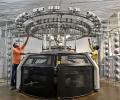
Manufacturing companies have been outperformers on the bourses in the current year, leading to a rise in their weighting in the benchmark index. Companies in sectors such as FMCG, automobile, pharmaceuticals, metals, cement, and agrochemicals now account for 25.43 per cent of the Nifty 50 index, up 88 basis points from 24.55 per cent at the end of December last year and a record low of 23.1 per cent at the end of CY20. The manufacturing sector is now dominated by FMCG majors such as Hindustan Unilever, ITC, Asian Paints, Nestle, and Britannia, accounting for 45 per cent of the combined market cap of all manufacturing companies in the index.

An opportunity to enter a burgeoning sector at a low valuation and favourable policies are propelling some of India's largest corporate groups to scoop up drone start-ups. "Indian corporations lost the race in aerospace and space tech. "No one wants to miss the bus this time. "These are seasoned businessmen and they realise that the market cap of tech companies with problem-solving capabilities will exponentially rise in future," says Vipul Singh, CEO of Aarav Unmanned Systems (AUS).

PowerGrid was the top gainer in the Sensex pack, rallying over 4 per cent, followed by NTPC, UltraTech Cement, Tech Mahindra, Reliance Industries and IndusInd Bank.

Eight of the top-10 most valued companies suffered a combined erosion of Rs 2,61,812.14 crore in market valuation last week, with Reliance Industries emerging as the biggest laggard. In the top-10 list, Infosys and Wipro were the only gainers. During the last week, the BSE benchmark slumped 1,774.93 points or 3.01 per cent.

The combined market valuation of eight of the top-10 most valued companies zoomed Rs 190,571.55 crore last week, with Bajaj Finance emerging as the biggest gainer, reflecting bullish investor sentiment. While Reliance Industries Ltd (RIL) and Tata Consultancy Services (TCS) witnessed erosion in their market capitalisation, rest of the eight companies including Hindustan Unilever Limited, HDFC, ICICI Bank and Bharti Airtel emerged as gainers. The market valuation of Bajaj Finance jumped Rs 35,878.56 crore to Rs 2,63,538.56 crore, becoming the biggest gainer among the top-10 most valued firms.
Indian asset management companies (AMCs) are likely to see a hefty spike in their valuations, after the last week's 5 per cent equity stake sale by Reliance Mutual Fund to US-based hedge fund Eton Park.

Tata Steel was the top gainer in the Sensex pack, jumping around 4 per cent, followed by NTPC, PowerGrid, Reliance Industries and Bajaj Finserv.
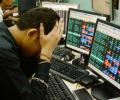
Equity benchmark Sensex slumped over 1,000 points to sink below the 55,000-level on Friday, tracking deep losses in IT, finance, banking and energy stocks amid widespread selling in the global markets. A weak rupee, surging crude prices and relentless foreign capital outflows further weighed on sentiment, traders said. The 30-share BSE index ended 1,016.84 points or 1.84 per cent lower at 54,303.44.

Over the past one-and-half years, the number of stocks trading below their respective face value has increased 29 per cent after a sharp correction in stocks of small-cap companies.

Apple's stock rose 5.89 per cent to a record-high close of $201.50 on Wednesday following the company's better-than-expected quarterly results.

HCL Tech was the top loser in the Sensex pack, shedding over 3 per cent, followed by Infosys, Bajaj Finserv, NTPC, ICICI Bank and IndusInd Bank.
The ownership by domestic investors, individual as well as institutional, in companies listed on the National Stock Exchange (NSE) has breached the 25 per cent mark for the first time. The share stood at 25.72 per cent at the end of the March 2023 quarter, up from 24.44 per cent in the previous quarter, according to data from Prime Database. The share of foreign portfolio investors (FPIs), meanwhile, rose slightly to 20.56 per cent from 20.24 per cent as on December 31, 2022.

Reliance Jio has suggested an alternative plan to the The Telecom Regulatory Authority of India (Trai) under which spectrum required by non-geostationary orbit satellite (NGSO) operators to run their gateway terminals should be auctioned geographically, based on districts, rather than circles as done for mobile services. For spectrum which would be required to connect user terminals (like individual homes), Jio has suggested it should be auctioned frequency-wise and exclusively to an operator at a pan-India level. The move is significant as the auctioning of satellite space spectrum has been vehemently opposed by low earth orbit satellite operators (satellites which circle at low altitudes of 200-2000 km).
Anil Ambani-controlled Reliance Capital Ltd said on Tuesday that it did not have any discussions with ICICI Bank for picking up its stake in Federal Bank.

Reliance Industries Limited (RIL) has been one of the top performing companies in the large cap space under the chairmanship of Mukesh Ambani and has beaten the broader market both in terms of earnings growth and shareholder returns. In the last 20 years, RIL's net profit has grown at a compound annual growth rate (CAGR) of 15.7 per cent while its net sales have grown at a CAGR of 15.1 per cent. RIL's net profit at consolidated level has jumped 18.5 times in the last two decades growing from Rs 3280 crore in FY02 to Rs 60,705 crore in FY22; its net sales grew 16.6 times from Rs 42,129 crore to Rs 6.99 trillion.

After a turnaround in performance by Indian equity markets since July that has seen the S&P BSE Sensex and the Nifty50 wipe out the year-to-date losses, analysts suggest investors start nibbling into stocks that are focused on the domestic economy. While they say intermittent corrections, led by policies of global central banks and other economic data, cannot be ruled out, analysts expect India's relative outperformance among global equity markets to continue as it looks better placed with a healthy economic recovery, and remains one of the fastest growing major economies. In this backdrop, Neeraj Chadawar, head of quantitative equity strategy at Axis Securities, believes that amid global slowdown, aggressive tightening by the central banks, and preference for domestic interests first (by the local government), export-oriented themes are likely to be muted or will deliver conservative returns in the near-term.

Days after the Cabinet approved doubling of natural gas price from April next year, the Finance Ministry has written to Oil Ministry suggesting setting of a ceiling or an upper limit for the rates.

Analysts caution against volatility and recommend buying stocks of companies that are on strong fundamental footing that have been beaten down badly in the recent carnage.

"This is a huge positive and is expected to bring in $8-10 bn capital in the industry."

Omkeshwar Singh, head, Rank MF, a mutual fund investment platform, answers your queries.

It goes without saying that the best performers are in the private sector, says TN Ninan.

Benchmark indices bounced back on Wednesday after falling for five straight sessions, with investors snapping up the recently-mauled IT, finance and consumption stocks amid a supportive trend overseas. A rebounding rupee further bolstered sentiment, traders said. Halting its five-session slide, the BSE Sensex jumped 574.35 points or 1.02 per cent to finish at 57,037.50. Similarly, the NSE Nifty surged 177.90 points or 1.05 per cent to 17,136.55.
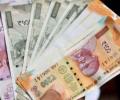
The rupee extended its losses and slipped 12 paise to 77.74 against the US dollar in early trade on Thursday, weighed down by a muted trend in domestic equities and unabated foreign fund outflows. At the interbank foreign exchange, the rupee opened at 77.72 against the American dollar, then lost ground to quote at 77.74, registering a fall of 12 paise from the last close. On Wednesday, the rupee declined by 1?7 paise to close at its fresh lifetime low of 77.6?1 against the US dollar.
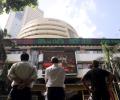
The bulk of the erosion in terms of value took place in India's most-valued firms. For instance, Mukesh Ambani-led Reliance Industries alone has lost Rs 3.8 trillion in m-cap, followed by HDFC Bank, which has seen its value erode by Rs 2.45 trillion and Tata Consultancy Services (TCS), which has lost Rs 1.85 trillion to stand at Rs 6.24 trillion, making it India's most-valued.

Omkeshwar Singh, Head, Rank MF, a mutual fund investment platform, answers your queries.
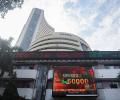
The top 10 valued firms added a total Rs 1,56,317.17 crore to their market valuation last week, helped by across the board rally which catapulted the benchmark index Sensex to the record 60,000 mark for the first time. During the last week, the 30-share BSE benchmark rallied 1,032.58 points or 1.74 per cent. The BSE Sensex made history on Friday by reaching the 60,000-mark for the first time ever. The market capitalisation (mcap) of Reliance Industries zoomed Rs 58,671.55 crore to reach Rs 15,74,052.03 crore. The m-cap of RIL went past Rs 16 lakh crore mark in intra-day trade on Thursday following a rally in its share price.
From the 30-share pack, Sun Pharma, TCS, Tech Mahindra, NTPC, Wipro, UltraTech Cement, Dr Reddy's Laboratories and Infosys were the major gainers, jumping up to 3.99 per cent. In contrast, Tata Steel, Nestle, Titan Company, PowerGrid, Reliance Industries Limited and State Bank of India were among the laggards.

'India has entered an economic super-cycle driven by a housing cycle turnaround.'

India's aviation industry could return to profitability in 2023-24 for the first time since the pandemic. The industry may pare aggregated net loss by 75-80 per cent year-on-year (YoY) to between Rs 3,500 crore and Rs 4,500 crore in 2022-23 (FY23), compared with Rs 17,500 crore of net losses in 2021-22 (FY22). A combination of recovery in passenger volumes and easing cost pressures due to stable fuel and foreign exchange (forex) costs could spark a turnaround. CRISIL says domestic and international passenger traffic recovered to 90 per cent and 98 per cent, respectively, of pre-pandemic traffic (2019-20, or FY20), in April-December 2022, compared with April-December 2019.

The Adani story has only one angle -- how the stocks were rigged up to ridiculous heights, the Hindenburg report on gross overvaluation, followed by the vertical free fall of Adani stocks, points out Debashis Basu.

In terms of market capitalisation, Zee alone has a market cap of Rs 24,000 crore compared to Rs 15,000 crore of the merged Reliance entity.

IndusInd Bank was the top loser in the Sensex pack, shedding around 4 per cent, followed by PowerGrid, ICICI Bank, HDFC Bank, Axis Bank and Bajaj Finance. NSE Nifty dipped 7.60 points to 14,736.40.
Around 75 per cent, or 372 stocks, that are part of the BSE500 are trading at least 10 per cent below their all-time high levels, despite the index hitting a record high 20,515 points on the BSE in intra-day trade on Wednesday, surpassing its previous high of 20,390 touched in March 12. The index, which accounts for 93 per cent of BSE listed companies' market capitalisation, has gained 8 per cent from its recent low of 18,983, touched on April 19. In comparison, the benchmark S&P BSE Sensex gained 6 per cent over the same period, but is still nearly 4.5 per cent away from its all-time high of 52,517 that it hit on February 16.
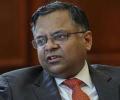
The group began to outperform the broader market only with the onset of the pandemic in March 2020 while earlier it was largely keeping pace with the Sensex. The group's market cap is up 164.4 per cent since the end of March 2020 against a 105 per cent rally in the Sensex.

HDFC Bank was the top loser in the Sensex pack, shedding nearly 2 per cent, followed by HDFC, Bajaj Finance, NTPC, Maruti, Kotak Bank and PowerGrid. The NSE Nifty fell 24.30 points to 18,044.25.
Mid caps need a longer investment time frame than large caps, because of their inherent nature
